google.com, pub-9591068673925608, DIRECT, f08c47fec0942fa0 All Posts - MEDIA MONITORING OIL AND GAS -->

Complete Graphic Design Course™

Saturday, October 14, 2017

Commerce Gas Margin Will Be Set at 7%


The ESDM Ministry will soon issue a Regulation of the Minister of EMR regarding the determination of gas trading margin.

The Ministry of Energy and Mineral Resources (ESDM) in the near future will issue a regulation to set the trade margin and the Internal Rate of Return (IRR) of gas transport. This rule is to respond to the decline in gas prices that have not been done for all specific industries.

Currently the draft of gas transportation margin restriction rules is final and has been submitted to the Coordinating Ministry for Marine Affairs for harmonization.

Deputy Minister of Energy and Mineral Resources Arcandra Tahar stated, the government will prepare a maximum of commercial margins and IRR through this rule.

"The ministerial regulation is over, 11 percent rate of return and general trading business margin of 7 percent," said Arcandra, Friday (10/13).

The gas trading margin determination plan has long been echoed. However, since March 2017, the ESDM Ministry began drafting ministerial regulations on the determination of gas trading margins. At the beginning of the discussion, the government plans to set a 5% commercial gas margin. However, gas traders protest because they consider the 5% margin too small.

The government finally set a 7% commercial gas margin. Issuance of downstream gas margin rules for the government to fulfill pledges to reduce gas prices. The high price of gas to consumers is caused by the high cost of distribution and gas transmission by traders and gas transporters.

From the Notes of the Directorate General of Oil and Gas at the Ministry of Energy and Mineral Resources, downstream gas prices with upstream gas prices differ considerably. If the price of gas in the upstream is only US $ 5-6 per mmbtu, the price of gas in the downstream until the final consumer can be US $ 14 per mmbtu. This means that the distribution and transmission costs are US $ 8 per mmbtu.

Industrial gas users also feel the price of distribution and transmission costs are quite high. According to the General Chairman of the Forum for Natural Gas Industry (FIPGB), Achmad Safiun, distribution and transmission costs are one of the causes of expensive gas prices.

"There is inefficiency in transmission," he said.

Public Relations & Corporate Social Responsibility Manager of PT Pertamina Gas Hatim Ilwan said the government had discussed the regulation plan with the business actors of gas distribution and transmission. The ministry actively involves the business world including Pertagas in this rule, Hatim said. 

Hatim said that the regulation of the gas trade margin contributes well to the growth of Pertagas's business.

"The rules are quite fair," he said.

Director of Commercial Gas Company of State, Danny Praditya also hope, the rules of gas trading can make the development of gas infrastructure is increasing. That way can create a new market. Danny is optimistic that if transparent and accountable governance rules, the domestic gas industry can flourish.

"From the start of determining the allocation of gas into the entitlement (rights) of the government up to midstream-downstream infrastructure, it is expected that no duplication of infrastructure will potentially harm the state finances and cause inefficiency, firmly danny.

IN INDONESIA

Margin Niaga Gas Akan Dipatok Sebesar 7%

Kementerian ESDM segera menerbitkan Peraturan Menteri ESDM mengenai penetapan margin niaga gas.

    Kementerian Energi dan Sumber Daya Mineral (ESDM) dalam waktu dekat akan menerbitkan aturan untuk menata margin niaga dan Internal Rate of Return (IRR) transportasi gas. Aturan ini untuk merespon adanya penurunan harga gas yang belum juga dilakukan untuk semua industri tertentu.

    Saat ini draf aturan pembatasan margin transportasi gas sudah final dan telah diserahkan ke Kementerian Koordinator Bidang Kemaritiman untuk dilakukan harmonisasi.

    Wakil Menteri ESDM Arcandra Tahar menyatakan, pemerintah akan menyiapkan maksimal margin niaga dan IRR melalui aturan ini. 

"Peraturan menterinya sudah selesai. Rate of return 11% dan margin usaha niaga umum 7%," jelas Arcandra, Jumat (13/10).

Rencana penetapan margin niaga gas sudah lama didengungkan. Namun, sejak Maret 2017, Kementerian ESDM mulai menyusun draf peraturan menteri mengenai penetapan margin niaga gas. Pada awal pembahasan, pemerintah berencana menetapkan margin niaga gas hanya 5%. Namun, trader gas memprotes lantaran menganggap margin 5% terlalu kecil.

Pemerintah pun akhirnya menetapkan margin niaga gas sebesar 7%. Penerbitan aturan margin hilir gas agar pemerintah bisa memenuhi janji menurunkan harga gas. Tingginya harga gas ke konsumen salah satunya disebabkan tingginya biaya distribusi dan transmisi gas oleh trader dan transporter gas.

Dari Catatan Direktorat Jenderal Migas Kementerian ESDM, harga gas di hilir dengan harga gas di hulu memiliki perbedaan cukup jauh. Jika harga gas di hulu hanya US$ 5-6 per mmbtu, harga gas di hilir hingga konsumen akhir bisa US$ 14 per mmbtu. Artinya biaya distribusi dan transmisi US$ 8 per mmbtu.

Pemakai gas industri juga merasakan harga biaya distribusi dan transmisi cukup tinggi. Menurut Ketua Umum Forum Industri Pengguna Gas Bumi (FIPGB), Achmad Safiun, biaya distribusi dan transmisi jadi salah satu penyebab harga gas mahal. 

"Ada inefisiensi di transmisi," katanya.

Public Relations & Corporate Social Responsibility Manager PT Pertamina Gas Hatim Ilwan menyatakan pemerintah telah mendiskusikan rencana aturan dengan pelaku usaha distribusi dan transmisi gas. Kementerian secara aktif melibatkan dunia usaha termasuk Pertagas di aturan ini," kata Hatim.

Hatim menyebut, pengaturan margin niaga gas ini berkontribusi baik bagi pertumbuhan usaha Pertagas. 

"Aturan yang cukup fair," ujarnya. 

Direktur Komersial Perusahaan Gas Negara, Danny Praditya juga berharap, aturan tata niaga gas tersebut bisa membuat pengembangan infrastruktur gas semakin meningkat. Dengan begitu bisa menciptakan pasar baru. Danny optimistis, jika aturan tata kelola transparan dan akuntabel, industri gas dalam negeri bisa berkembang. 

"Dari mulai penetapan alokasi gas yang menjadi entitlement (hak) pemerintah sampai dengan infrastruktur midstream-downstream, diharapkan tidak lagi terjadi duplikasi infrastruktur yang berpotensi merugikan keuangan negara dan menyebabkan inefisiensi, tegas danny.

Kontan, Page-14, Saturday, October 14, 2017

Friday, October 13, 2017

Regulation of Upstream Oil and Gas Assets Makes It Complicated Bureaucracy


Structuring of state property

The cooperation contract contractor hopes that the ESDM Ministry will revise the regulation on state property in the upstream oil and gas sector as it adds the length of the bureaucratic chain. The Government issued Regulation of the Minister of Energy and Mineral Resources No. 51/2017 on the Guidance and Governance of State Property on Upstream Oil and Gas Business Activities on August 9, 2017.

Executive Director of Indonesian Petroleum Association (IPA) Marjolijn Wajong said that the Ministry of Energy and Mineral Resources (ESDM) will change some points in Minister of Energy and Mineral Resources Regulation No. 51/2017. In fact, the rule was just published on August 9, 2017.

Under the regulation, the contractor of a Cooperation Contract (KKKS) obliged to keep the state property (BMN) in the integrated storage also pays the rent on the storage of certain goods. An integrated storage area is a government-designated place to store items other than unused land and buildings.

To use integrated storage, KKKS must pay a set amount of fees on mutual agreement. The KKKS must also incur costs to transport the goods and to the integrated storage area. The Government will then designate the location of the integrated storage area by considering the number of KKKS operating in a certain Territory. 

     When the regulation is in force, state property currently held in a storage facility already owned by the KKKS may be continued during the supervision of the state-owned goods management center (PPBMN).

"We hear information if the Ministry of Energy and Mineral Resources plans to make changes to the Regulation of the Minister of Energy and Mineral Resources," he said.

Currently the Indonesian Oil Association (IPA) is in discussions with the government. The reason, MArjolijn said the good rules should not extend the bureaucratic chain because of the increasing parties involved.

The regulation states that the KKKS must report to the Head of the State Property Management Center related to the needs planning, procurement, purchase realization and utilization. In addition, reporting should also be made to the list goods stored, as well as for maintenance, transfer of hands to destruction.

"The IPA will remain in discussions with the Government so that the regulation can make national oil and gas activities reach optimum efficiency levels instead of extending the bureaucratic chain due to the increasing number of stakeholders involved."

When confirmed, Head of Communications Bureau, Information Services and Cooperation Dadan Kusdiana said it has no plans to amend Regulation of Minister of Energy and Mineral Resources No. 51/2017.

"No revision plan yet."

Previously, Upstream Oil and Gas Analyst Wood Mackenzie Johan Utama said that any regulation that adds bureaucracy also limits the movement of business actors will reduce the interest of business actors.

"Regulations that are considered to limit or add to the complexity of bureaucracy in a sector will further undermine investor interest."

He considered that the recently published regulation had a negative response and business actor. Against the negative response of business actors, the government revised regulations. On the positive side, Marjolijn said that the government would respond to the complaints of business actors.

IN INDONESIA

Regulasi Aset Hulu Migas Bikin Rumit Birokrasi


Kontraktor kontrak kerja sama berharap agar Kementerian ESDM merevisi aturan tentang penataan barang milik negara di sektor hulu minyak dan gas bumi karena justru menambah panjang rantai birokrasi. Pemerintah menerbitkan Peraturan Menteri ESDM Nomor 51/2017 tentang Pembinaan dan Tata Kelola Barang Milik Negara pada Kegiatan Usaha Hulu Minyak dan Gas Bumi pada 9 Agustus 2017.

Direktur Eksekutif Indonesian Petroleum Association (IPA) Marjolijn Wajong mengatakan bahwa Kementerian Energi dan Sumber Daya Mineral (ESDM) akan mengubah beberapa poin dalam Peraturan Menteri ESDM Nomor 51/2017. Padahal, aturan itu baru saja diterbitkan pada 9 Agustus 2017.

Melalui aturan tersebut, kontraktor kontrak kerja sama (KKKS) Wajib menyimpan barang milik negara (BMN) di tempat penyimpanan terpadu juga membayar sewa atas penyimpanan barang tertentu. Tempat penyimpanan terpadu merupakan tempat yang ditunjuk pemerintah untuk menyimpan barang-barang selain tanah dan bangunan yang tidak digunakan. 

Untuk menggunakan ternpat penyimpanan terpadu, KKKS harus membayar sejumlah biaya yang ditetapkan atas kesepakatan bersama. KKKS juga harus mengeluarkan biaya untuk mengangkut barang dan dan menuju tempat penyimpanan terpadu. 

     Pemerintah nantinya menunjuk lokasi tempat penyimpanan terpadu dengan mempertimbangkan jumlah KKKS yang beroperasi di Wilayah tertentu. Saat peraturan berlaku, barang milik negara yang saat ini disimpan di tempat penyimpanan yang telah dimiliki KKKS bisa diteruskan selama dalam pengawasan pusat pengelola barang milik negara (PPBMN).

“Kami mendengar informasi jika pihak Kementerian ESDM berencana melakukan perubahan pada Peraturan Menteri ESDM tersebut,” ujarnya.

Saat ini Asosiasi Minyak Indonesia (IPA) sedang berdiskusi dengan pemerintah. Pasalnya, Marjolijn menyebut aturan yang baik seharusnya tidak memperpanjang rantai birokrasi karena bertambahnya pihak-pihak yang terlibat.

Dalam aturan itu disebutkan bahwa KKKS wajib melapor kepada Kepala Pusat Pengelola Barang Milik Negara terkait dengan perencanaan kebutuhan, pengadaan, realisasi pembelian dan pemanfaatan. Selain itu, pelaporan juga harus dilakukan untuk daftar barang yang disimpan, juga untuk pemeliharaan, pemindah tanganan hingga pemusnahan.

“IPA akan tetap berdiskusi dengan Pemerintah agar peraturan tersebut dapat membuat kegiatan migas nasional mencapai tingkat efisiensi yang optimal bukan malahan memperpanjang rantai birokrasi akibat bertambahnya stakeholder yang terlibat.”

Saat dikonfirmasi, Kepala Biro Komunikasi, Iayanan lnformasi dan Kerja Sama Dadan Kusdiana mengatakan, pihaknya belum memiliki rencana untuk mengubah Peraturan Menteri ESDM Nomor 51/2017. 

“Belum ada rencana revisi.”

Sebelumnya, Analis Hulu Minyak dan Gas Bumi Wood Mackenzie Johan Utama mengatakan bahwa regulasi apa pun yang menambah birokrasi juga membatasi gerak pelaku usaha akan mengurangi minat pelaku usaha.

“Regulasi yang dianggap membatasi atau menambah kerumitan birokrasi di suatu sektor akan semakin mengurangi minat investor.”

Dia menilai bahwa regulasi yang baru saja diterbitkan mendapat respons negatif dan pelaku usaha. Terhadap respons negatif pelaku usaha, pemerintah melakukan revisi peraturan. Sisi positifnya, Marjolijn menyebut pemerintah mau merespons keluhan pelaku usaha.

 Bisnis Indonesia, Page-30, Friday, October 13, 2017

PGN Saka Eyeing of Two New Blocks


Saka Energi Indonesia (PGN Saka) is eyeing two new blocs that are auctioned by the government. Currently, this state-owned oil and gas company takes the auction document of Working Area (WK) of oil and gas. In total there are two oil and gas blocks that Saka requested in this year's oil and gas auction.

President Director of PGN Saka, Tumbur Parlindungan through External Relations, Zsa Zsa Ryzki confirmed, it took the auction documents WK it. The plan, PGN Saka will bid ahead of the deadline for submission of bids set by the government.

"We intend to take two blocks. If Saka take, it would be good, "he said.

It said the two blocks are Pekawai Block in East Kalimantan and West Yamdena Block on Natuna Beach. The region is a oil and gas block that has been conducted joint study between Saka and the government.

Map of Working Area Oil and Gas

"In addition to the two blocks we hope to join the termination blocks. One of them took part in the termination block that was handed over government to Pertamina. If Pertamina does not want 100 percent, it can be given to us, "he added.

Map of ownership of oil and gas territories of foreign countries in Indonesia

One of the Saka Sanga blocking blocks is the Sanga-Sanga Block. Currently Saka has about 37 percent participating interest (PI) in the Sanga-Sanga block. Saka is also a joint operator with Wni who also has a PI of about 37 percent.

"The government gives Pertamina for further management. He said would want to find a partner, we want to be a partner. Saka is already there, "he explained.

While Saka hopes to get an assignment from the government, Saka also apparently continues to develop the blocks that operated. One of them blocks Ujung Pangkah. Tumbur said recently Saka has proposed Plan of Development (POD) for Ujung Pangkah Block Gresik to SKK Migas.

"Drilling already last year, currently in the POD stage," explained Tumbur.

If the POD is approved this year, Tumbur projects that the Ujung Pangkah Block Sedayu can be onstream by 2019. Oil production from the field will be around 105,000 barrels of oil per day (BOPD).

IN INDONESIA

PGN Saka Incar Dua Blok Baru


Saka Energi Indonesia (PGN Saka) mengincar dua blok baru yang dilelang pemerintah. Saat ini BUMN Migas ini mengambil dokumen lelang Wilayah Kerja (WK) migas. Totalnya ada dua blok migas yang diminati oleh Saka dalam lelang WK migas tahun ini.

Direktur Utama PGN Saka, Tumbur Parlindungan melalui External Relation, Zsa Zsa Ryzki membenarkan, pihaknya mengambil dokumen lelang WK tersebut. Rencananya, PGN Saka akan mengajukan penawaran jelang batas akhir pengajuan penawaran yang ditetapkan pemerintah. 

”Kami niatnya mengambil dua blok. Kalau Saka ambil, pasti bagus,” ujarnya.

Dikatakan, kedua blok itu adalah Blok Pekawai di Kalimantan Timur dan Blok West Yamdena di Pantai Natuna. Wilayah tersebut merupakan blok migas yang telah dilakukan joint studi antara Saka dan pemerintah.

“Selain dua blok itu kami berharap bisa ikut masuk ke blok-blok terminasi. Salah satunya ikut dalam blok terminasi yang diserahkan pemerintah ke Pertamina. Kalau Pertamina tidak mau 100 persen, boleh diberikan kepada kami,” imbuhnya. 

Salah satu blok terminasi yang diincar Saka adalah Blok Sanga-Sanga. Saat ini Saka memiliki sekitar 37 persen participating interest (PI) di blok Sanga-Sanga. Saka juga menjadi operator bersama dengan Wni yang juga memiliki PI sekitar 37 persen.

”Pemerintah memberi Pertamina untuk pengelolaan selanjutnya. Katanya mau mencari partner, kami mau menjadi partner. Saka sudah ada disitu,” terangnya.

Sambil Saka berharap mendapat penugasan dari pemerintah, Saka juga ternyata terus mengembangkan blok-blok yang dioperatorinya. Salah satunya blok Ujung Pangkah. Tumbur bilang baru-baru ini Saka telah mengajukan Plan of Development (POD) untuk Blok Ujung Pangkah Gresik ke SKK Migas. 

”Pengeboran sudah tahun lalu, saat ini dalam tahap POD,”terang Tumbur.

Jika POD tersebut disetujui tahun ini, Tumbur memproyeksi Lapangan Sedayu Blok Ujung Pangkah paling cepat bisa onstream pada 2019. Produksi minyak dari lapangan tersebut akan berkisar 105.000 barell oil per day (BOPD).

Radar Gresik, Page-4, Friday, October 13, 2017

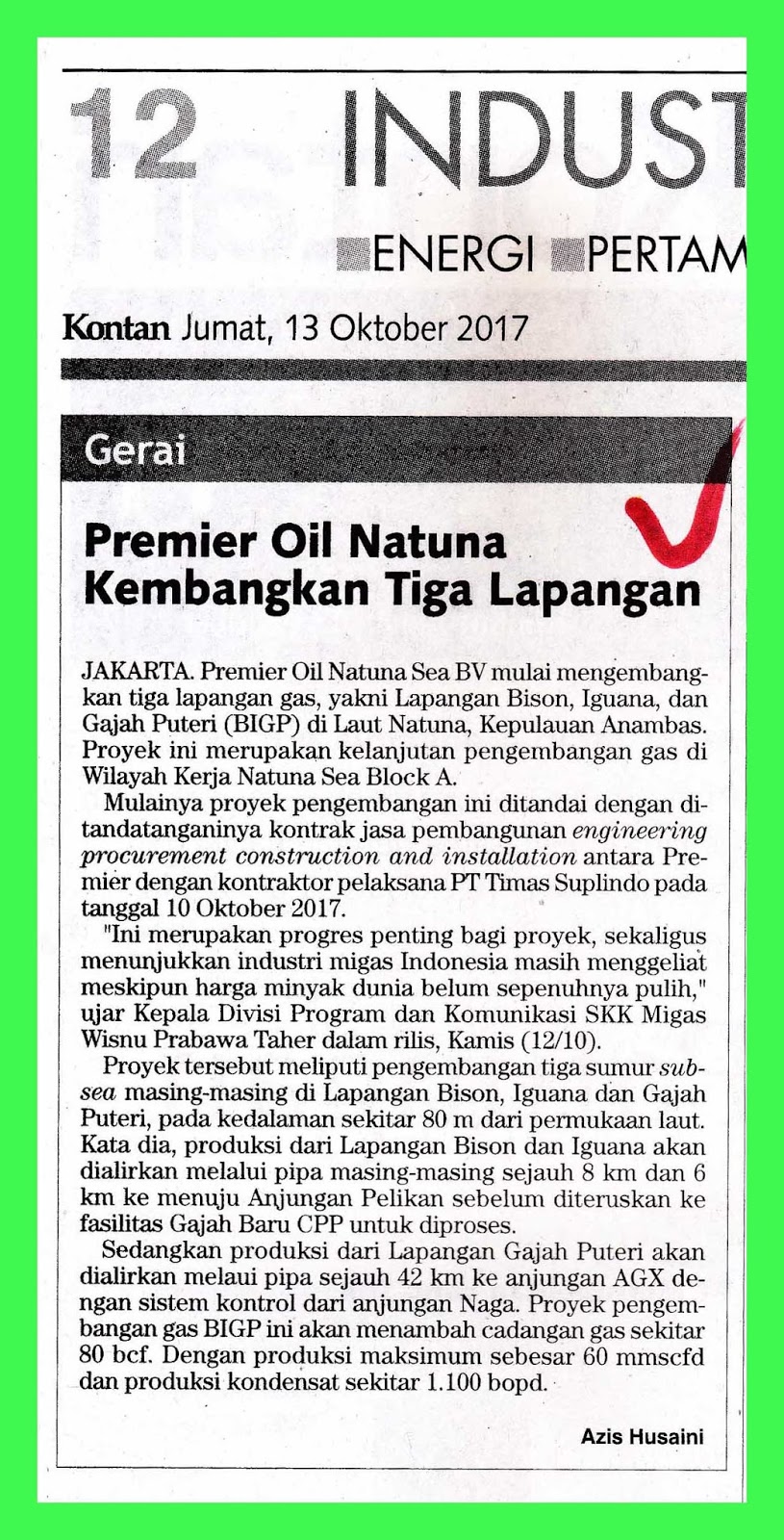
Premier Oil Natuna Develops Three Fields


Premier Oil Nauma Sea BV began developing three gas fields, namely Bison Field, Iguana, and Elephant Princess (BIGP) in Natuna Sea, Anambas Islands. This project is a continuation of gas development in Natuna Sea Block A. Working Area

The beginning of this development project is marked by the signing of an engineering construction services procurement construction and installation contract between Premier and PT Timas Suplindo's contractor on October 10, 2017.

"This is an important progress for the project, as well as showing Indonesia's oil and gas industry is still stretched even though the world oil price has not fully recovered," said Head of Program and Communication Division of SKK Migas Wisnu Prabawa Taher in a release on Thursday (12/10).

The project includes the development of three subsea wells in Bison, Iguana and Elephant Princess fields, at a depth of approximately 80 m above sea level.

Production from Bison and Iguana Fields will be flown through pipes of 8 km and 6 km to the Pelikan Pavilion before being forwarded to the New Elephant CPP facility for processing. While the production from Gajah Puteri Field will be streamed through the pipeline as far as 42 km to the AGX platform with a control system of the Dragon's platform. The BIGP gas development project will add about 80 bcf of gas reserves. With a maximum production of 60 mmscfd and condensate production of about 1,100 bopd.

IN INDONESIA


Premier Oil Natuna Kembangkan Tiga Lapangan


Premier Oil Nauma Sea BV mulai mengembangkan tiga lapangan gas, yakni Lapangan Bison, Iguana, dan Gajah Puteri (BIGP) di Laut Natuna, Kepulauan Anambas. Proyek ini merupakan kelanjutan pengembangan gas di Wilayah Kerja Natuna Sea Block A.

Mulainya proyek pengembangan ini ditandai dengan ditandatanganinya kontrak jasa pembangunan engineering procurement construction and installation antara Premier dengan kontraktor pelaksana PT Timas Suplindo pada tanggal 10 Oktober 2017.

"Ini merupakan progres penting bagi proyek, sekaligus menunjukkan industri migas Indonesia masih menggeliat meskipun harga minyak dunia belum sepenuhnya pulih," ujar Kepala Divisi Program dan Komunikasi SKK Migas Wisnu Prabawa Taher dalam rilis, Kamis (12/10).

Proyek tersebut meliputi pengembangan tiga sumur subsea masing-masing di Lapangan Bison, Iguana dan Gajah Puteri, pada kedalaman sekitar 80 m dari permukaan laut. 

Produksi dari Lapangan Bison dan Iguana akan dialirkan melalui pipa masing-masing sejauh 8 km dan 6 km ke menuju Anjungan Pelikan sebelum diteruskan ke fasilitas Gajah Baru CPP untuk diproses. Sedangkan produksi dari Lapangan Gajah Puteri akan dialirkan melaui pipa sejauh 42 km ke anjungan AGX dengan sistem kontrol dari anjungan Naga. Proyek pengembangan gas BIGP ini akan menambah cadangan gas sekitar 80 bcf. Dengan produksi maksimum sebesar 60 mmscfd dan produksi kondensat sekitar 1.100 bopd.

Kontan, Page-12, Friday, October 13, 2017

Pertamina Wins World Award


PT Pertamina through Pertamina Refinery Unit (RU) VI Balongan won the World Safety Organization (WSO) award for WSO Concern Company category. The first award of this Indonesian representative was received by Vice President of Health Safety Environment Refinery, Mahendrata at the annual WSO congress which was held at the Tuscany Casino Hotel, Las Vegas, USA.

Vice President Corporate Cormmunication Pertamina explains, there are different in this World Safety Organization (WSO) congress, because for the first time Indonesia sent a nomination in the arena of awards the world's safety organizations. As a result, two Indonesian representatives won the award.

"At the time of the company's efforts to improve the performance of HSSE, one of Pertamina's business units received recognition from the WSO congress. It will be the motivation for the company to implement safety and security principles in every sphere company work "he said.

The congress was attended by representatives from various countries in Europe, Asia, Africa, Middle East, and Canada. Congress which was opened by WSO Director, Mr. Lon S. McDanie discusses various safety issues, including transportation safety, in construction safety, oil and gas safety, chemical safety, public safety and others.

Representative of Indonesia Soehatman Ramli as National Office Indonesia said that Pertamina Refinery Unit (RU) VI Balongan won prestigious award in WSO because of various achievements that have been achieved for the category of company, while for other Indonesian representatives, Dr. Waluyo Marto Wiyoto received awards for WSO Citizen category Awards.

"Pertamina RU VI Balongan is deemed to be eligible for awards due to various achievements achieved during the operation, such as safe working hours has reached 98 million more without accidents, the Company predicate Gold Proper, ISRS level 8, and many more achievements that have been achieved," said Soehatman Ramli.

IN INDONESIA


Pertamina Raih Penghargaan Tingkat Dunia


PT Pertamina melalui Pertamina Refinery Unit (RU) VI Balongan meraih penghargaan World Safety Organization (WSO) untuk kategori WSO Concern Company. Perhargaan pertama kali dari perwakilan Indonesia ini diterima oleh Vice President Health Safety Environment Refinery, Mahendrata dalam kongres tahunan WSO yang kali ini digelar di Hotel Tuscany Casino, Las Vegas, Amerika Serikat.

Vice President Corporate Cormmunication Pertamina menjelaskan, ada yang berbeda dalam kongres World Safety Organization (WSO) ini, karena untuk pertama kalinya Indonesia mengirimkan nominasi dalam arena penghargaan organisasi keselamatan dunia tersebut.  Hasilnya dua perwakilan Indonesia meraih penghargaan.

“Di saat upaya perusahaan untuk meningkatkan kinerja HSSE, salah satu unit bisnis Pertamina mendapatkan pengakuan dari kongres WSO. Ini akan menjadi motivasi bagi perusahaan untuk mengimplentasikan prinsip-prinsip keamanan dan keselamatan di setiap lingkup kerja perusahaan" katanya.

Kongres tersebut dihadiri oleh perwakilan dari berbagai negara di Eropa, Asia, Afrika, Timur Tengah, dan Kanada. Kongres yang dibuka oleh Director WSO, Mr. Lon S. McDanie ini membahas berbagai isu keselamatan, di antaranya transportation safety, in construction safety, oil and gas safety, chemical safety, public safety dan lainnya.

Perwakilan Indonesia Soehatman Ramli selaku National Office Indonesia mengatakan, Pertamina Refinery Unit (RU) VI Balongan meraih penghargaan bergengsi di WSO karena berbagai prestasi yang selama ini dicapainya untuk kategori perusahaan, sementara untuk perwakilan Indonesia lainnya, Dr Waluyo Marto Wiyoto menerima penghargaan untuk kategori WSO Citizen Awards.

“Pertamina RU VI Balongan dinilai berhak memperoleh penghargaan karena berbagai prestasi yang dicapai selama beroperasi, seperti jam kerja aman sudah mencapai 98 juta lebih tanpa kecelakaan, Perusahaan berpredikat Proper Emas, ISRS level 8, dan masih banyak lagi prestasiprestasi yang sudah diraih,” kata Soehatman Ramli.

Investor Daily, Page-5, Thursday, October 12, 2017

Pertagas to resolve series of inefficiencies


PT Pertamina Gas (Pertagas), a subsidiary of state-owned energy giant Pertamina, has given gas trader PT Mutiara Energy until the end of this year to settle all of its unpaid debts that have reportedly weighed on the former’s performance. Otherwise, legal action will be taken.

The Supreme Audit Agency (BPK) has recently announced the results of its audit on Pertagas’ financial' performance, in which the agency found a number of irregularities in the company’s gas trade and transportation businesses from 2014 to the first half of 2016. 

According to the BPK, Pertagas had to bear losses worth US$ 16.57 million from the impairment of bad debts totaling $ 11.86 million from gas sales to Mutiara Energy.

Pertagas president director Suko Hartono said the company would do everything it could to force Mutiara Energy to settle the unpaid debts, while adding that warning letters had been sent twice to the latter last year.

“We’re optimistic that unpaid debts from Mutiara Energy can be settled in the near future in accordance with existing regulations, or before the end of 2017 at the latest,” Suko said recently.

Meanwhile, Pertagas public relations manager Hatim Ilwan said if Mutiara Energy failed to settle its debts by the designated deadline, his side would take the case to the court. Prominent economist Faisal Basri has long criticized Pertagas’ gas trading scheme, in which the company sells most of its gas to dozens of traders in a lengthy supply chain, resulting in bloated gas prices.

According to his research in 2014, Pertagas sold its gas to trader PT Odira, which would later resell the gas to Mutiara Energy at a price of $ 9 per million British Thermal Units (MMBTU). Then, the gas would have to go through two other traders before being received by PT Torabika as the end-user at a price of $ 14.5 per MMBTU.

The BPK has also pointed out the inefficiency of Pertagas’ gas transportation business, particularly in the use of the company’s pipelines connecting Belawan with Medan Industrial Area (KIM) and Sei Mangkei Special Economic Zone (KEK) in Sumatra. According to the BPK, the pipeline project, estimated to be worth nearly $60 million, may weigh on Pertagas’ financial performance in the long run because, among other things, there have been no firm off-takers for the gas transported through the facility.

The Belawan-KIM pipeline is initially expected to transport 89 million standard cubic feet per day (MMSCFD) of gas, While the KIM-KEK pipeline is projected to transport 40 MMSCFD of gas. Pertagas has conducted another feasibility study and recalculated the economic value of the project according to the real conditions in the field.

“In the future, Pertagas won’t just focus on gas transportation business as we will also boost gas trading through aggressive marketing activities,” said Suko, While adding that such an effort would help increase the utilization of Pertagas’ pipelines.

At present, Pertagas is also in the process of developing gas transmission pipelines spanning 267 kilometers from Gresik in East Java to Semarang in Central Java, which have an' investment value of around $ 515.7 million. The Gresik-Semarang pipelines, expected to be completed in mid-2018, will transport gas sourced from the Jambaran Tiung Biru field in East Java, operated by another Pertamina subsidiary Pertamina EP Cepu.

Within the first eight months of 2017, Pertagas recorded $ 90.6 million in net profit, up 108 percent compared to the same period last year.

Jakarta Post, Page-14, Thursday, October 12, 2017

Water Usage in Oil and Gas Industry is inevitable


Ministry of Energy and Mineral Resources (ESDM will draft Regulation of the Minister of Energy and Mineral Resources on the Determination of the Value of Acquisition of Ground Water (NPA) on Upstream Oil and Gas Activities, this Regulation of the Minister of EMR to determine the certainty of the threshold of the determination of Income Tax (PPh) by the regional government.

"Water is an inevitable part, if this is a high income tax, certainly the upstream oil and gas business is not economical anymore," explained Minister of ESDM Ignasius Jonan, through a press release on Wednesday (11/10).

In the new regulation that will in addition to accommodate regional interests related to efforts to obtain the original income, as well as the sustainability of the upstream oil and gas business activities. 

    Currently, the determination of NPA based on the Decree of the Minister of Home Affairs Number 12/2002 which states, for the district or city is Rp 125 per m3 and ground water tax is obtained through the calculation of Water Volume X Rp 125 per m3 X 20% (maximum withdrawal).

But with the issuance of Law (Law) No. 23 of 2014 on Regional Government. Determination of the NPA which previously became the authority of the regent or mayor turned to the Governor. 

     Following the Law, the value of groundwater stipulation refers to Government Regulation No. 55 of 2016 and Regulation of the Minister of Energy and Mineral Resources number 20/2017 concerning Guidelines for Establishing the Value of Ground Water. Therefore, the Directorate General of Oil and Gas Ego Syahrial stated that it does not give value on the acquisition of land so that the oil and gas industry can be more economical.

IN INDONESIA

Pemakaian Air di Industri  Migas Tak Terhindarkan


Kementerian Energi dan Sumber Daya Mineral (ESDM akan merancang Peraturan Menteri ESDM tentang Penetapan Nilai Perolehan Air Tanah (NPA) pada Kegiatan Hulu Migas, Peraturan Menteri ESDM ini untuk menentukan kepastian batas ambang penetapan Pajak Penghasilan (PPh) oleh pemerintah daerah. 

"Air ini bagian yang tidak terhindarkan. Kalau ini dikenakan pajak penghasilan yang tinggi, tentu usaha hulu migas tidak ekonomis lagi," jelas Menteri ESDM Ignasius Jonan, melalui siaran pers, Rabu (11/10).

Dalam regulasi baru itu nantinya selain mengakomodasi kepentingan daerah terkait upaya mendapatkan Pendapatan Asli Daerah, juga keberlangsungan usaha kegiatan hulu migas. 

     Saat ini penetapan NPA berdasarkan Keputusan Menteri Dalam Negeri Nomor 12/2002 yang menyebutkan, untuk kabupaten atau kota adalah sebesar Rp 125 per m3 dan pajak air tanah diperoleh melalui perhitungan Volume air X Rp 125 per m3 X 20% (maksimal penarikan).

Namun seiring terbitnya Undang-Undang (UU) Nomor 23 Tahun 2014 tentang Pemerintahan Daerah. Penetapan NPA yang sebelumnya menjadi kewenangan bupati atau Walikota beralih kepada Gubernur. 

     Setelah UU tersebut, nilai penetapan air tanah mengacu Peraturan Pemerintah Nomor 55 Tahun 2016 dan Peraturan Menteri ESDM nomor 20/2017 tentang Pedoman Penetapan Nilai Perolehan Air Tanah. Untuk itu Direktorat Jenderal Migas Ego Syahrial menyatakan, tidak memberikan nilai atas perolehan atas tanah agar industri migas bisa lebih ekonomis.

Kontan, Page-14, Thursday, October 12, 2017