google.com, pub-9591068673925608, DIRECT, f08c47fec0942fa0 All Posts - MEDIA MONITORING OIL AND GAS -->

Complete Graphic Design Course™

Friday, December 15, 2017

Oil and Gas Production This Year Approximately 99% of Target


The Upstream Oil and Gas Upstream Business Unit (SKK Migas) said that until the end of the year, oil and gas lifting could reach 99 percent of this year's Revised State Budget target of 1.97 million barrels of oil equivalent per day (boepd). If detailed, the APBN-P 2017 target of oil reaches 815,000 barrels per day (bpd) and gas is 6,440 mmscfd.

Head of Program and Communication Division SKK Migas Wisnu Prabawa Taher stated, although not reaching 100% of the target, the achievement was good. Because, during this year there was some development in the field of oil and gas is not optimal and there is a decrease in natural production is greater than the estimates SKK Migas.

"In some fields, the natural decline is estimated to be between 10% and 15%, even 20% -25%," he said.

In addition, Head of SKK Migas Amien Sunaryadi some time ago also said, factors that make lifting does not reach 100% for example because gas in Block Simenggaris no buyer. Then, there is the incident of platform rigs in the West Offshore Madura Block (WMO) belonging to PT Pertamina Hulu Energi WMO tilted, resulting in disturbance of production facilities (unplanned shutdown).

Moreover, the old oil and gas pipes, so that production is restrained.

"This year a lot of unplanned shutdown, especially if Field Banyu Urip dead a day, can go down," said Amien.

Then the oil and gas reserves are also not expected to reach the target because the Kasuri Kasuri plan of development (PoD) has not been completed yet. Kasuri Block is predicted to produce gas 285 mmscfd.

"If the Cassowary Block operates, the target can pass," he said.

While the investment projection until the end of the year is only US $ 10.5 billion-US $ 11 billion. In a note to SKK Migas at the end of November 2017 upstream oil and gas investments that enter only US $ 8 billion-US $ 9 billion of the target of US $ 12 billion this year.

Although not able to invest in this year. SKK Migas believes next year oil and gas investment will be bigger, reaching US $ 12 billion. This is because oil prices are starting to rise.

"KKKS activities can increase in 2018, of course also for exploration," said Vishnu.

Next year, it is predicted that the investment portion of exploration activities can reach 10-15 percent of the total investment in 2018. Meanwhile, next year's oil and gas production target is projected to reach 2 million boepd. The achievement of production can be achieved with new projects and maximum production achievement in a number of production blocks by 2017.

"There are four peak production phase projects and five new PODs in 2018," he added.

Wisnu said several projects to be started next year include Block A which is projected to produce 70 mmscfd of gas. There is also a Cricket Project which will reach the peak of production next year. The current gas production from the Cricket Project has reached 600 mmscfd.

Upstream Director of Pertamina Syamsu Alam said upstream production is achieved, until the end of November 2017 already 693,000 boepd with oil and gas each contributing 50%.

"The greatest contribution from Pertamina EP Cepu is 80,000 bpd," said Syamsu, and the second contribution came from PT Pertamina EP and PHE.

Although some targets are not reached, SKK Migas can still smile broadly because the state revenue exceeds the target.

"Outlook is about US $ 13 billion from US $ 12.2 billion this year," said Vishnu.

Amien said oil and gas revenues are encouraged because the price of Indonesian crude oil or Indonesian Crude Price (ICP) continues to increase.

"So it is not the achievement of SKK Migas, he said.

The Ministry of Finance is also relieved by the trend in the oil and gas industry.

"If the state revenue passes the target the Finance Minister is happy," he said.

IN INDONESIA

Produksi Migas Tahun Ini Sekitar 99% dari Target 


Satuan Kerja Khusus Pelaksana Kegiatan Usaha Hulu Minyak dan Gas Bumi (SKK Migas) menyatakan hingga akhir tahun lifting migas bisa mencapai 99% dari target APBN-P tahun ini sebesar 1,97 juta barrels oil equivalent per day (boepd). Jika didetailkan, target APBN-P 2017 minyak mencapai 815.000 barel per hari (bph) dan gas 6.440 mmscfd.

Kepala Divisi Program dan Komunikasi SKK Migas Wisnu Prabawa Taher menyatakan, meskipun tidak mencapai 100% dari target, pencapaian itu sudah bagus. Sebab, sepanjang tahun ini terjadi beberapa pengembangan di lapangan migas yang tidak optimal dan ada penurunan produksi secara alamiah yang lebih besar dari perkiraan SKK Migas. 

"Di beberapa lapangan, penurunan alamiah diperkirakan 10%-15% ini malah 20%-25%. ltu wajar sebetulnya karena kita dominan lapangan tua," ungkapnya, Kamis (14/12).

Selain itu, Kepala SKK Migas Amien Sunaryadi beberapa waktu lalu juga bilang, faktor yang membuat lifting tidak mencapai 100% misalnya karena gas di Blok Simenggaris belum ada pembeli. Lalu, ada kejadian platform rigs di Blok West Offshore Madura (WMO) milik PT Pertamina Hulu Energi WMO miring, sehingga terjadi gangguan fasilitas produksi (unplanned shutdown).

Apalagi pipa-pipa migas yang sudah tua, sehingga produksi tertahan. 

"Tahun ini banyak yang unplanned shutdown, apalagi kalau Lapangan Banyu Urip mati sehari saja, bisa turun," ungkap Amien.

Kemudian cadangan migas juga diperkirakan tidak mencapai target karena plan of development (PoD) Blok Kasuri belum selesai. Blok Kasuri diprediksi dapat memproduksi gas 285 mmscfd. 

"Kalau Blok Kasuari beroperasi, target bisa melewati," ujarnya.

Sementara proyeksi investasi hingga akhir tahun hanya US$ 10,5 miliar-US$ 11 miliar. Dalam catatan SKK Migas pada akhir November 2017 investasi hulu migas yang masuk hanya US$ 8 miliar-US$ 9 miliar dari target US$ 12 miliar tahun ini.

Meski tidak bisa mengenjot investasi pada tahun ini. SKK Migas yakin tahun depan investasi migas akan lebih besar, yakni mencapai US$ 12 miliar. Ini karena harga minyak mulai naik. 

"Kegiatan KKKS bisa meningkat di tahun 2018, tentu saja juga untuk eksplorasi," ujar Wisnu.

Tahun depan diprediksi bagian investasi kegiatan eksplorasi bisa mencapai 10%-15% dari total seluruh investasi tahun 2018. Sementara, target produksi migas tahun depan diproyeksikan bisa mencapai 2 juta boepd. Pencapaian produksi itu bisa dicapai dengan proyek baru dan pencapaian produksi maksimal di sejumlah blok berproduksi pada tahun 2017.

"Ada empat proyek fase puncak produksi dan lima POD baru di 2018," imbuhnya.

Wisnu menyatakan, beberapa proyek yang akan dimulai tahun depan di antaranya adalah Blok A yang diproyeksi bisa menghasilkan gas sebesar 70 mmscfd. Ada juga Proyek Jangkrik yang tahun depan akan mencapai puncak produksi. Saat ini produksi gas dari Proyek Jangkrik sudah mencapai 600 mmscfd.

Direktur Hulu Pertamina Syamsu Alam mengatakan, produksi hulu tercapai, sampai akhir November 2017 sudah 693.000 boepd dengan minyak dan gas masing-masing memberikan kontribusi 50%. 

“Paling besar kontribusi dari Pertamina EP Cepu sebesar 80.000 bph," kata Syamsu. Lalu kontribusi kedua datang dari PT Pertamina EP dan PHE. 

Meski beberapa target tak tercapai, SKK Migas masih bisa tersenyum lebar karena pendapatan negara melebihi target. 

"Outlook sekitar US$ 13 miliar dari US$ 12,2 miliar tahun ini," ujar Wisnu.

Amien mengatakan, pendapatan migas terdorong karena harga minyak mentah Indonesia atau Indonesian Crude Price (ICP) terus meningkat.

"Jadi bukan prestasi SKK Migas, kata dia.

Kementerian Keuangan juga lega dengan tren di industri migas ini. 

“Jika penerimaan negara melewati target Menteri Keuangan senang," katanya.

Kontan, Page-14, Friday, Dec 15, 2017

Lifting Under Target


The average production of ready-to-sell oil during January-December 12, 2017 reached 802,199 barrels per day (bpd) or 98.43% of the target in the APBN 2017 Changes of 815,000 bpd. The average production of natural gas ready for sale (lifting) during January-December 12, 2017 reached 7.6.20 million cubic feet (Mlvlscfd) or 118.32% of the target of 6240 MMscfd.

Head of SKK Migas Amien Sunaryadi said that the target of oil lifting is difficult to achieve. The reason, towards the end of the year, the average oil and gas production has not reached the target.

"Approximately lifting 2017 will only reach about 98% and the target set in APNBP 2017, he said, Thursday (14/12).

Based on SKK Migas data, as of December 12, 2017, oil and condensate production reached 786,504 bpd and natural gas 7,824 MMscfd. Meanwhile, total oil and gas lifting during January-December 12, 2017 reached 1.94 million barrels of oil equivalent per day (boepd or 97.96% of the target set in AP 201 P revenues of 1.96 million boepd.

Although lifting this year will not be achieved, the country's revenue from the sector is expected to exceed the target until the end of the year. State revenue target of oil and gas in APBNP 2017 amounted to US $ 12.2 billion.

"Our state revenue from oil and gas will be above 100%. It's from lifting everything, "he said.

Previously, upstream oil and gas analyst Wood Mac Johan Utama said that to be able to achieve the production target set by the government needed even harder efforts. The rate of decline in production is classified faster, so that may be done that is slow the rate of decline.

The contractor needs a very high cost to keep oil and gas production down. Steps to halt oil and gas field operations will result in production down. Based on SKK Migas data of third quarter / 2017, the highest production decrease of Sanga-Sanga Block is 25% with production realization of 40,572 boepd.

Decrease in production in SES Block 4% with production realization 52,944 boepd. East Kalimantan and Attaka blocks fell 3% with 34,315 boepd of oil and gas production.

IN INDONESIA

Lifting di Bawah Target


Rerata produksi minyak siap jual selama Januari-12 Desember 2017 mencapai 802.199 barel per hari (bph) atau 98,43% dari target dalam APBN Perubahan 2017 sebanyak 815.000 bph. Rerata produksi gas bumi siap jual (lifting) selama Januari-12 Desember 2017 mencapai 7.6.20 juta kaki kubik (Mlvlscfd) atau 118,32% dari target 6.440 MMscfd.

Kepala SKK Migas Amien Sunaryadi mengatakan bahwa target lifting minyak tersebut sulit tercapai. Pasalnya, menjelang akhir tahun, rata-rata produksi migas masih belum mencapai target.

“Kira-kira lifting 2017 hanya akan tercapai sekitar 98 % dan target yang ditetapkan dalam APNBP 2017  tuturnya, Kamis (14/12).

Berdasarkan data SKK Migas, per 12 Desember 2017, produksi minyak dan kondensat mencapai 786.504 bph dan gas bumi 7.824 MMscfd. Sementara itu, total lifting migas selama Januari-12 Desember 2017 mencapai 1,94 juta barel setara minyak per hari (boepd atau 97,96% dari target yang ditetapkan dalam APBN P 2017 sebesar 1,96 juta boepd.

Kendati lifting pada tahun ini tidak akan tercapai, pendapatan negara dari sektor tersebut diperkirakan melampaui target hingga akhir tahun. Target penerimaan negara dari migas dalam APBNP 2017 sebesar US$ 12,2 miliar. 

“Penerimaan negara kita dari migas akan di atas 100%. Itu dari lifting semuanya,” katanya.

Sebelumnya, analis hulu migas Wood Mac Johan Utama mengatakan bahwa untuk bisa mencapai target produksi yang telah ditetapkan pemerintah diperlukan upaya lebih keras lagi. Laju penurunan produksi tergolong lebih cepat, sehingga yang mungkin bisa dilakukan yakni memperlambat laju penurunan.

Kontraktor membutuhkan biaya sangat tinggi untuk menjaga produksi migas tidak turun. Langkah untuk menghentikan operasi lapangan migas akan mengakibatkan produksi turun. Berdasarkan data SKK Migas kuartal III/2017, penurunan produksi tertinggi Blok Sanga-Sanga sebesar 25 % dengan realisasi produksi 40.572 boepd. 

Penurunan produksi di Blok SES 4% dengan realisasi produksi 52.944 boepd. Blok East Kalimantan dan Attaka turun 3% dengan produksi migas sebanyak 34.315 boepd.

Bisnis Indonesia, Page-30, Friday, Dec 15, 2017

Pertamina One Step Again


PT Pertamina will certainly manage Mansouri Block, oil and gas area in Iran.

Business Sources knowing the negotiation process of the Government of Indonesia with the Government of Iran revealed that Pertamina immediately managed the Mansouri Block.

The Iranian government gave Pertamina exclusive rights to manage the block. Besides Mansouri, Pertamina also targeted Ab Teymour Block. However, Pertamina must compete with contractors from other countries to be able to have a share of participation in Ab Teymour.

Oil reserves from both oil and gas blocks in Iran reached 3 billion barrels. In fact, oil reserves in Indonesia currently only about 3.3 billion barrels.

With a reserve of 3.3 billion barrels, oil production will be exhausted within 11 years with no record of finding new reserves. Initially, the Government of Indonesia rejected Iran's offer to MAPNA, an Iranian-owned power company, in cooperation with PT Perusahaan Listrik Negara in the electricity sector. However, the government finally agreed on Iran's offer so that Pertamina could have a share of participation in the Mansouri Block.

EMR Deputy Minister of Energy Arcandra Tahar said that energy security does not have to be met and domestic sources. Japan for example, as a country that has no energy source, but is able to maintain energy security through import and investment of oil and gas in other countries.

This will be done Pertamina to increase oil and gas investment abroad so that it can strengthen the national oil and gas reserves. Head of Communications, Public Information Service and Cooperation Bureau of the Ministry of ESDM Agung Pribadi said it was not aware of the plan to sign oil and gas cooperation between Indonesia and Iran. According to him, there is no such schedule in January 2018.

"There is no such information, maybe Pertamina knows more details," he said on Thursday (14/12).

PT Pertamina will sign a Mansouri Block management contract in Iran by 2018. Upstream Director of Pertamina Syamsu Alam said earlier it will control 30 percent participation share and an Iranian partner of 20 percent. The remaining 50%, Pertamina will partner with other partners to manage the block with the type of Service Contract. The Iranian government has decided to sign the contract next year, April 2018.

"Well the Iranian government is requesting the signing of the year-end contract, April."

According to him, there are already other partners who showed interest to participate in managing the Mansouri Block. However, he was reluctant to mention because it is still in the conversation stage. The plan, Mansouri Block produces 250,000 to 300,000 barrels per day (bpd). From the oil produced, he called the company will bring it to Indonesia to meet the needs of fuel oil (BBM).

Mansouri is one of two blocks planned by Pertamina. Previously, there was the Ab-Teymour Block which was also included in the radar in order to increase the company's oil and gas production but ultimately only Mansouri could be agreed upon.

Quoted from the official website of NIOC, Iran will auction off 50 working areas with a profit sharing system. The main point in the contract is, as quoted from the page Herbert Smith Freehills, an international law firm, Iran uses a system of contracts that allow investors to refund costs

For the exploration period, 4 years is set with 2 year extension. Meanwhile, for the development and production stage is set 20 years. The government will set production targets but will provide incentives for investors who can maximize field management.

Meanwhile, the change in cooperation contracts, referring to the page, because Iran wants to achieve the target of US $ 150 billion investment that must enter for the next 5 years.

"Pertamina is 30% -an, 20% local, the rest we are looking for partners [partners]," said Syamsu.

IN INDONESIA

Pertamina Selangkah Lagi


PT Pertamina dipastikan akan mengelola Blok Mansouri, wilayah minyak dan gas bumi di Iran.

Sumber Bisnis yang mengetahui proses negosiasi Pemerintah Indonesia dengan Pemerintah Iran mengungkapkan, Pertamina segera mengelola Blok Mansouri.

Pemerintah Iran memberikan hak eksklusif kepada Pertamina untuk mengelola blok tersebut. Selain Mansouri, Pertamina juga mengincar Blok Ab Teymour. Namun, Pertamina harus bersaing dengan kontraktor dari negara lain untuk dapat memiliki saham partisipasi di Ab Teymour.

Cadangan minyak dari kedua blok migas di Iran itu mencapai 3 miliar barel. Padahal, cadangan minyak di Indonesia saat ini hanya sekitar 3,3 miliar barel.

Dengan cadangan 3,3 miliar barel, produksi minyak akan habis dalam waktu 11 tahun dengan catatan tidak ada penemuan cadangan baru. Pada awalnya, Pemerintah Indonesia menolak penawaran Iran agar MAPNA, perusahaan listrik milik Iran, bekerja sama dengan PT Perusahaan Listrik Negara di sektor kelistrikan. Namun, pemerintah akhirnya menyepakati penawaran Iran itu sehingga Pertamina bisa memiliki saham partisipasi di Blok Mansouri. 

Wakil Menteri ESDM Arcandra Tahar mengatakan bahwa ketahanan energi tidak harus dipenuhi dan sumber dalam negeri. Jepang misalnya, sebagai negara yang tidak memiliki sumber energi, tetapi mampu menjaga ketahanan energi baik melalui impor maupun investasi migas di negara lain.

Hal tersebut yang akan dilakukan Pertamina untuk meningkatkan investasi migas di luar negeri sehingga bisa memperkuat cadangan migas nasional. Kepala Biro Komunikasi, Layanan Informasi Publik, dan Kerja Sama Kementerian ESDM Agung Pribadi mengatakan pihaknya belum mengetahui rencana penandatanganan kerja sama di bidang migas antara Indonesia dengan Iran.  Menurutnya, belum ada jadwal tersebut pada Januari 2018.

"Belum ada infomiasi seperti itu. Mungkin Pertamina lebih tahu detailnya," ujarnya Kamis (14/12).

PT Pertamina akan menandatangani kontrak pengelolaan Blok Mansouri di Iran pada 2018. Direktur Hulu Pertamina Syamsu Alam sebelumnya mengatakan pihaknya akan menguasai saham partisipasi sebesar 30% dan mitra Iran sebesar 20%. Sisanya sebesar 50%, Pertamina akan menggandeng mitra lain untuk mengelola blok dengan jenis Service Contract itu. Pemerintah Iran telah menetapkan agar penandatanganan kontrak dilakukan tahun depan, yakni April 2018. 

"Nah Pemerintah Iran yang minta penandatanganan kontrak akhir tahun, April."

Menurutnya, sudah ada mitra lain yang menunjukkan minat untuk turut terlibat mengelola Blok Mansouri. Namun, dia enggan menyebut karena masih dalam tahap pembicaraan. Rencananya, Blok Mansouri menghasilkan 250.000 hingga 300.000 barel per hari (bph). Dari minyak yang dihasilkan, dia menyebut perseroan akan membawanya ke Indonesia untuk memenuhi kebutuhan bahan bakar minyak (BBM).

Mansouri merupakan satu dari dua blok yang rencananya dikuasai Pertamina. Sebelumnya, terdapat Blok Ab-Teymour yang juga masuk dalam radar agar bisa menambah produksi migas perseroan tapi akhirnya hanya Mansouri yang bisa disepakati.

Dikutip dari laman resmi NIOC, Iran akan melelang 50 wilayah kerja dengan sistem kontrak bagi hasil. Poin utama dalam kontrak kerja sama tersebut, seperti dikutip dari laman Herbert Smith Freehills, satu firma hukum internasional, Iran menggunakan sistem kontrak yang memungkinkan pengembalian biaya investor 

Untuk masa eksplorasi, ditetapkan 4 tahun dengan perpanjangan 2 tahun. Sementara itu, untuk tahap pengembangan dan produksi ditetapkan 20 tahun. Pemerintah akan menetapkan target produksi tapi akan disiapkan insentif bagi investor yang bisa memaksimalkan pengelolaan lapangan.

Adapun, perubahan kontrak kerja sama, mengacu pada laman itu, dikarenakan Iran ingin mencapai target investasi US$150 miliar yang harus masuk selama 5 tahun ke depan.

" Pertamina bagiannya 30%-an, 20% lokal, sisanya kita lagi mencari partner [mitra]," kata Syamsu. 

Bisnis Indonesia, Page-3, Friday, Dec 15, 2017

2019, Pertamina-Saudi Aramco Forms Joint Ventures


The establishment of a joint venture (JV) between PT Pertamina and Saudi Aramco for repair and capacity building of Cilacap Refinery will be realized in 2019.

Director of Processing and Petrochemistry Megawroyek Ardhy Mokobombang said the establishment of a joint venture with Saudi Aramco takes a long time because the sequence is different. The Saudi Arabian oil and gas company called for the creation of a new joint venture after the front end engineering design (FEED) finishes.

"The estimate (establishment of JV) by the end of 2019 is over. Because of his studies only 1.5. year, "he said on the sidelines of Pertamina Energy Forum 2017 in Jakarta, Wednesday (13/12).

Therefore, the company and Saudi Aramco need to revise the previously signed joint venture agreement (JVA) agreement.

A revision is needed so that Pertamina and Saudi Aramco can work on the FEED study, without having to form a joint venture first. This JVA revision is targeted as soon as possible.

"Possibility of January (signing JVA)" said Ardhy.

Related to the ownership of shares, he asserted no change. Pertamina will still hold a 55% stake in the upgrading project of Cilacap Refinery. The reason, the company wants to be able to control a joint venture with Saudi Aramco.

"Share it affects how we control the joint venture so if we are minimum position, of course its position is not good. This is our own refinery, "he said.

After the joint venture agreement is signed, Pertamina-Aramco will start FEED work. In the next year, the company also targets clarity on asset transfer and fiscal incentives in the form of tax holiday. Later, Pertamina's current assets will be included in the joint venture.

"Later we are talking about the existing access entered into the joint venture," said Ardhy.

The Cilacap refinery is targeted to start operating in 2023 from the initial plan of 2022. After the upgrading, the processing capacity of Cilacap refinery will increase from 348 thousand bpd to 400 thousand bpd.

Furthermore, there will be additional gasoline production of 80 thousand bpd, diesel fuel 60 thousand bpd, and avtur 40 thousand bpd. Fuel production rose significantly as the ability of refineries to process crude oil into finished products (NCI) rose from 74% to 92-98%.

IN INDONESIA

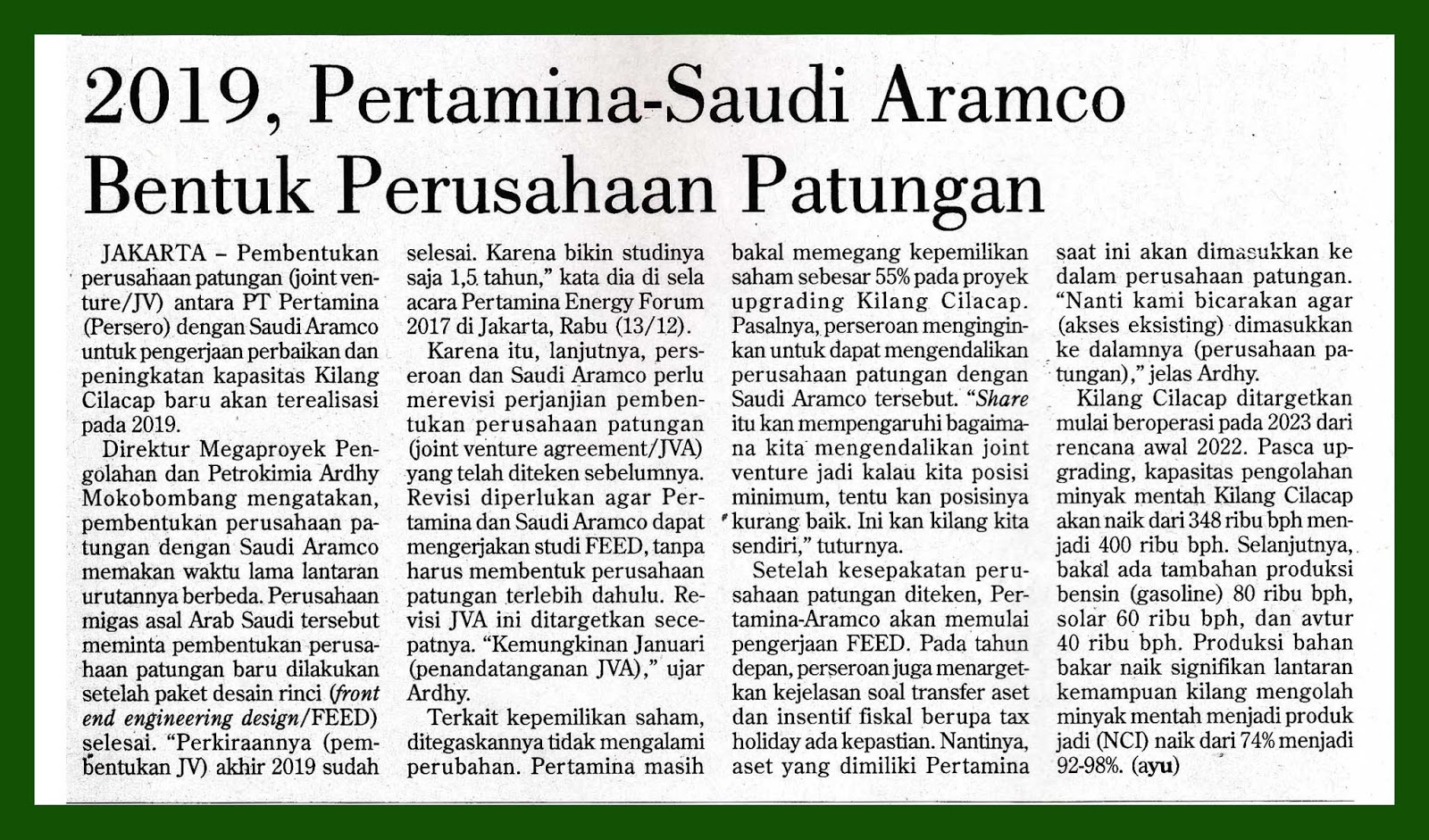
2019, Pertamina-Saudi Aramco Bentuk Perusahaan Patungan

Pembentukan perusahaan patungan (joint venture/JV) antara PT Pertamina dengan Saudi Aramco untuk pengerjaan perbaikan dan peningkatan kapasitas Kilang Cilacap akan terealisasi pada 2019.

Direktur Megaproyek Pengolahan dan Petrokimia Ardhy Mokobombang mengatakan, pembentukan perusahaan patungan dengan Saudi Aramco membutuhkan waktu lama karena urutannya berbeda. Perusahaan migas asal Arab Saudi tersebut meminta pembentukan perusahaan patungan baru dilakukan setelah paket desain rinci (front end engineering design/FEED) selesai. 

“Perkiraannya (pembentukan JV) akhir 2019 sudah selesai. Karena membuat studinya saja 1,5. tahun,” kata dia di sela acara Pertamina Energy Forum 2017 di Jakarta, Rabu (13/12). 

Karena itu, perseroan dan Saudi Aramco perlu merevisi perjanjian pembentukan perusahaan patungan (ioint venture agreement/ JVA) yang telah diteken sebelumnya.

Revisi diperlukan agar Pertamina dan Saudi Aramco dapat mengerjakan studi FEED, tanpa harus membentuk perusahaan patungan terlebih dahulu. Revisi JVA ini ditargetkan secepatnya. 

“Kemungkinan Januari (penandatanganan JVA)" ujar Ardhy.

Terkait kepemilikan saham, ditegaskannya tidak mengalami perubahan. Pertamina masih bakal memegang kepemilikan saham sebesar 55% pada proyek upgrading Kilang Cilacap. Pasalnya, perseroan menginginkan untuk dapat mengendalikan perusahaan patungan dengan Saudi Aramco tersebut. 

“Share itu mempengaruhi bagaimana kita mengendalikan joint venture jadi kalau kita posisi minimum, tentu saja posisinya kurang baik. Ini kilang milik kita sendiri,” tuturnya.

Setelah kesepakatan perusahaan patungan ditandatangani, Pertamina-Aramco akan memulai pengerjaan FEED. Pada tahun depan, perseroan juga menargetkan kejelasan tentang transfer aset dan insentif fiskal berupa tax holiday ada kepastian.  Nantinya, aset yang dimiliki Pertamina saat ini akan dimasukkan ke dalam perusahaan patungan.

“Nanti kami bicarakan agar akses eksisting dimasukkan ke dalam perusahaan patungan,” jelas Ardhy.

Kilang Cilacap ditargetkan mulai beroperasi pada 2023 dari rencana awal 2022. Pasca upgrading, kapasitas pengolahan minyak mentah Kilang Cilacap akan naik dari 348 ribu bph menjadi 400 ribu bph. 

Selanjutnya, akan ada tambahan produksi bensin (gasoline) 80 ribu bph, solar 60 ribu bph, dan avtur 40 ribu bph. Produksi bahan bakar naik signifikan karena kemampuan kilang mengolah minyak mentah menjadi produk jadi (NCI) naik dari 74% menjadi 92-98%.

Investor Daily, Page-9, Thursday, Dec 14, 2017

The Minister of Minerals Affairs, Pertamina Not Allowed to Compensate


PT Pertamina through its subsidiary PT Pertamina EP as KKKS, is not allowed to issue funds if there are demands for compensation requested by illegal miners who are grabbing oil wells in their working areas.

"Also called illegal, wild. Pertamina or other KKKS may not spend funds for illegal activities. What is needed is the socialization of the activities of grabbing and drilling of oil wells. That's the job of everything, especially the government and SKK Migas and KKKS, "said Vice Chairman of Commission VII of the House of Representatives Satya W Yudha in Jakarta.

Satya W Yudha


According to Satya, oil and gas is the domain of the central government. Therefore, all of its activities, including drilling, are carried out by a central government designated authority, the KKKS. If the community then drills, let alone grabs the oil wells in the working area of ​​the KKKS without the approval of the central government, the activity is illegal.

"That's what should be dealt with and socialized so that people understand what they are doing. Even if there are CSR funds (corporate social responsibility) issued KKKS, it does not mean a replacement of illegal drilling activities, "he said.

As reported earlier, on November 21, 2017, Police Resort Musi Banyuasin assisted by SKK Migas, Pertamina EP Asset 1 Field Ramba (operational unit of PT Pertamina EP), Musi Banyuasin Police Unit, Musi Banyuasin Military District Command, and ESDM South Sumatra , closes 20 state-owned oil wells in Mangunjaya, Babat-toman Sub-district, one of Pertamina EP Asset 1 Field Ramba's work areas.

However, the closure of the well has received resistance from illegal miners who do not want the wells closed and the stagger (tool to drill the well) is torn down. In fact, the day after closing, two wells were damaged / reopened by illegal miners. They even demanded compensation for the issued capital to mine wells in the working area of ​​Pertamina EP Asset 1 Field Ramba, in addition to requesting legalization of mining activities.

Imam Prihandono, an expert on oil and gas law from Airlangga University Surabaya, explains that illegal mining activities are very dangerous. The environmental damage and social impacts of the community due to illegal mining are the responsibility of the government.

"This happens in many illegal mining cases in Indonesia. The government allows illegal mining to earn certain benefits (corruption), "he said.

Oil and gas law observer and practitioner Hakim Nasution added that the government should be consistent in implementing Law no. 22 of 2001 on Oil and Gas. One clause in the Oil and Gas Law is that oil and gas exploration and exploitation activities are conducted by companies that have obtained government approval (SKK Migas).

"KKKS who are having problems with the illegal seizure of wells by illegal miners continue to coordinate with relevant parties, especially with the authorities," he said.

The judge also agreed with Satya Yudha's statement asking Pertamina not to meet the demands of illegal miners requesting compensation.

"If the demands are met will create a bad precedent and will give the wrong message to other violators," he said.

Risna Resnawaty, a CSR expert, assesses the socialization of illegal drilling hazards should be parallel with efforts to improve the welfare of communities around the mine. This issue should be a shared responsibility. Each relevant stakeholder should take part in implementing the responsibility of the community.

According to the Head of Social Welfare Studies Program Faculty of Social Sciences Political Sciences Padjadjaran University, Bandung, the first step that must be done by the government is to stabilize the condition of the community by conducting development planning for communities directly affected by illegal oil drilling activities. The second step, implementation by involving the company.

"In essence, development design and initiatives must be made by the government," he said.

IN INDONESIA


Tertibkan Penambang Liar, Pertamina Tidak Boleh Beri Ganti Rugi


PT Pertamina melalui anak usahanya PT Pertamina EP selaku KKKS, tidak diperbolehkan mengeluarkan dana apabila ada tuntutan ganti rugi yang diminta penambang liar yang menyerobot sumur minyak di wilayah kerja mereka.

“Disebut juga ilegal, liar. Pertamina atau KKKS lain tidak boleh mengeluarkan dana untuk kegiatan ilegal. Yang diperlukan adalah sosialisasi kegiatan penyerobotan dan pengeboran sumur minyak. Itu tugas semuanya, terutama pemerintah dan SKK Migas serta KKKS,” ujar Wakil Ketua Komisi VII Dewan Perwakilan Rakyat Satya W Yudha di Jakarta.

Menurut Satya, migas adalah domain pemerintah pusat. Karena itu, segala aktivitasnya, termasuk pengeboran, dilakukan oleh otoritas yang ditunjuk pemerintah pusat, yaitu KKKS. Apabila masyarakat kemudian mengebor, apalagi menyerobot sumur minyak yang ada di wilayah kerja KKKS tanpa persetujuan pemerintah pusat, aktivitas tersebut adalah ilegal.

“Itu yang harus ditindak dan disosialisasikan sehingga masyarakat paham apa yang mereka lakukan. Kalaupun ada dana CSR (corporate social responsibility) yang dikeluarkan KKKS, itu bukan berarti pengganti dari kegiatan illegal drilling," ujarnya.

Seperti diberitakan sebelumnya, pada 21 November 2017, Polisi Resort Musi Banyuasin dibantu oleh SKK Migas, Pertamina EP Asset 1 Field Ramba (unit operasional PT Pertamina EP), Satuan Polisi Pamong Praja Musi Banyuasin, Komando Distrik Militer Musi Banyuasin, dan Dinas ESDM Sumatera Selatan, menutup 20 sumur minyak milik negara di Mangunjaya, Kecamatan Babat-toman, salah satu wilayah kerja Pertamina EP Asset 1 Field Ramba.

Namun, penutupan sumur tersebut mendapat perlawanan oknum penambang liar yang tidak mau sumurnya ditutup dan stagger (alat bantu untuk mengebor sumur) dirobohkan. Bahkan, sehari setelah penutupan, dua sumur dirusak/dibuka kembali oleh penambang liar. Mereka bahkan menuntut ganti rugi modal yang dikeluarkan untuk menambang sumur di wilayah kerja Pertamina EP Asset 1 Field Ramba, selain meminta legalisasi atas kegiatan penambangan.

Imam Prihandono, pakar hukum migas dari Universitas Airlangga Surabaya menjelaskan kegiatan penambangan minyak secara liar sangat berbahaya. Kerusakan lingkungan dan dampak sosial kemasyarakatan akibat penambangan liar menjadi tanggungjawab pemerintah. 

“Ini terjadi di banyak kasus penambangan ilegal di Indonesia. Pemerintah membiarkan penambangan liar karena mendapatkan keuntungan tertentu (korupsi),” katanya.

Pengamat dan praktisi hukum migas Hakim Nasution menambahkan, pemerintah harus konsisten dalam menerapkan Undang-Undang No. 22 Tahun 2001 tentang Minyak dan Gas Bumi. Salah satu klausul dalam Undang-Undang Migas adalah kegiatan eksplorasi dan eksploitasi migas dilakukan oleh perusahaan yang telah mendapatkan persetujuan dari pemerintah (SKK Migas).

“KKKS yang mengalami persoalan dengan penyerobotan sumur oleh penambang liar terus berkoordinasi dengan pihak-pihak terkait, khususnya dengan pihak aparat,” ujarnya.

Hakim juga sepakat dengan pernyataan Satya Yudha yang meminta Pertamina tidak perlu memenuhi tuntutan penambang liar yang meminta kompensasi. 

“Jika tuntutan dipenuhi akan menciptakan preseden buruk dan akan memberikan pesan yang salah kepada para pelanggar Iainnya,” kata dia.

Risna Resnawaty, pakar CSR, menilai sosialisasi bahaya pengeboran minyak secara liar harus paralel dengan upaya peningkatan kesejahteraan masyarakat di sekitar tambang. Persoalan ini harus menjadi tanggung jawab bersama. Setiap pemangku kepentingan terkait harus ambil bagian dalam pelaksanan tanggungjawab terhadap masyarakat.

Menurut Ketua Program Studi Kesejahteraan Sosial Fakultas Ilmu Sosial Ilmu Politik Universitas Padjadjaran, Bandung ini, langkah pertama yang harus dilakukan pemerintah adalah menstabilkan kondisi masyarakat dengan melakukan perencanaan pengembangan terhadap masyarakat yang terkena dampak langsung dari kegiatan pengeboran minyak ilegal. Langkah kedua, implementasi dengan melibatkan perusahaan. 

“Intinya, desain pembangunan dan inisiatif harus dibuat oleh pemerintah,” katanya.

Investor Daily, Page-9, Thursday, Dec 14, 2017

Thursday, December 14, 2017

PGN Sells Gas Bontang Without Commission


PT Perusahaan Gas Negara Tbk (PGN) said that it did not get any reward for the sale of liquefied natural gas (LNG) part of the country produced by Bontang Refinery which is currently managed by PT Badak NGL, a subsidiary of PT Pertamina. The LNG sold by PGN comes from the Sanga-Sanga Block. Currently, Saka Energi, a subsidiary of PGN owns 26.25% stake in Sanga-Sanga.

The appointment of PGN as an uncommitted state-owned LNG seller will apply to the sales period of 2018. PGN's Corporate Secretary Rachmat Hutama explains that PGN's appointment as the LNG seller of the Sanga-Sanga Block is part of the country as a trust from the government.

He said the government's decision to set the issuer coded PGAS in Indonesia Stock Exchange as the seller of LNG of the state based on the letter of Head of SKK Migas Amien Sunaryadi. Through Letter dated December 4, 2017, SKK Migas appoints PGN as the seller of uncommited LNG Badak volumes with gas source from Sanga-Sanga.

Rachmat said PGN is in charge of carrying out LNG buying and selling with prospective buyers for the period of 2018 subject to the determination of LNG allocations and prices from the Minister of EMR.

"Furthermore, we can start negotiations with prospective buyers by continuing to coordinate with SKK Migas," said Rachmat, Wednesday (13/12).

With this appointment, PGN is responsible for submitting a written approval request on the sales mechanism to be used before marketing. In addition, it prepares and obtains approval of the sale and purchase agreement, to report the proceeds of sale each time the payment.

As an LNG seller, PGN is also required to bear all costs incurred first. Referring to the Letter, the fees and responsibilities will be treated as operating expenses. As a Bontang LNG seller, PGN will not be rewarded.

"We are optimistic with professional, transparent and accountable management, PGN can contribute more to the country," he said.

The Badak NGL LNG refinery processes gas supplies from several oil and gas projects, namely Mahakam Block, Bangka Field, Jangkrik Field, and Sanga-Sanga Block. This year, LNG production amounted to 7.84 million tons with shipments of 10.44 cargo standards.

IN INDONESIA

PGN Menjual Gas Bontang Tanpa Komisi

PT Perusahaan Gas Negara Tbk (PGN) menyatakan tidak mendapatkan imbalan atas penjualan gas alam cair (LNG) bagian negara yang diproduksi Kilang Bontang yang saat ini masih dikelola PT Badak NGL, anak usaha PT Pertamina. LNG yang dijual PGN itu berasal dari Blok Sanga-Sanga. Saat ini, Saka Energi, anak usaha PGN memiliki 26,25% saham di Sanga-Sanga.

Penunjukan PGN sebagai penjual LNG bagian negara yang belum terkontrak (uncommited) ini akan berlaku untuk periode penjualan tahun 2018. Sekretaris Perusahaan PGN, Rachmat Hutama menjelaskan, penunjukan PGN sebagai penjual LNG Blok Sanga-Sanga bagian negara ini sebagai sebuah kepercayaan dari pemerintah.

Dia bilang, keputusan pemerintah menetapkan emiten berkode PGAS di Bursa Efek Indonesia ini sebagai penjual LNG bagian negara berdasarkan surat Kepala SKK Migas Amien Sunaryadi. Lewat Surat tertanggal 4 Desember 2017, SKK Migas menunjuk PGN sebagai penjual uncommited volume LNG Badak dengan sumber gas dari Sanga-Sanga.

Rachmat menyatakan, PGN bertugas melaksanakan jual beli LNG dengan para calon pembeli untuk periode 2018 dengan tetap tunduk pada penetapan alokasi dan harga LNG dari Menteri ESDM. 

"Selanjutnya kami bisa memulai perundingan dengan calon pembeli dengan terus berkoordinasi dengan SKK Migas," ujar Rachmat, Rabu (13/12).

Dengan penunjukkan ini, PGN bertanggungjawab menyampaikan permohonan persetujuan secara tertulis mengenai mekanisme penjualan yang akan digunakan sebelum memasarkan. Selain itu, pihaknya menyiapkan dan memperoleh persetujuan atas perjanjian jual beli, hingga melaporkan hasil penjualan setiap kali pembayaran.

Sebagai penjual LNG, PGN juga wajib menanggung seluruh biaya yang timbul terlebih dulu. Merujuk Surat tersebut, mengenai biaya dan tanggung jawab akan diperlakukan sebagai biaya operasi. Sebagai penjual LNG Bontang, PGN tidak akan memperoleh imbalan. 

"Kami optimistis dengan pengelolaan secara profesional, transparan dan akuntabel, PGN dapat memberikan kontribusi lebih kepada negara," katanya.

Kilang LNG yang dikelola Badak NGL mengolah pasokan gas dari beberapa proyek migas, yakni Blok Mahakam, Lapangan Bangka, Lapangan Jangkrik, dan Blok Sanga-Sanga. Tahun ini, produksi LNG sebesar 7,84 juta ton dengan pengapalan sebanyak 10,44 standar kargo.

Kontan, Page-14, Thursday, Dec 14, 2017

Upstream Investment of Oil and Gas Missile


Decrease Greater than Projection

The realization of upstream oil and gas investment this year is estimated to miss the target of USD 12 billion. Special Unit for Upstream Oil and Gas Business Activities (SKK Migas) estimates that upstream oil and gas investment realization will only reach USD 10.5-11 billion.

Head of Program and Communications Division SKK Migas Wisnu Prabawa Taher stated, in the last two years upstream oil and gas investment in Indonesia fell due to low world oil prices.

"This decline is not only happening in Indonesia, but also occurs globally," he said.

The improving world oil price is expected to stimulate upstream oil and gas investment next year. Until the end of November, the realization of upstream oil and gas investment only reached USD 8-9 billion.

SKK Migas records the production of several exploration blocks that are still below target. Upstream oil and gas investment that continues to fall also affects the slashing target of lifting or production of ready-to-sell oil and gas this year. SKK Migas estimates that the oil lifting this year will only reach 99 percent of the target in the 2017 APBNP. That is, 815 thousand barrels per day.

"Some of the field experienced a decline in production greater than we expected, ie 10-15 percent. But, as it turns out, the rate of decline in production can be above that. Namely, reaching 20-25 percent, "he explained.

Meanwhile, next year SKK Migas estimates upstream oil and gas investment to reach USD 12 billion. The figure is still following the world oil price assumption of USD 48 per barrel. That is in accordance with the State Budget Expenditure Plan (RAPBN) 2018.

"The majority of investment comes from production and because we have to maintain production because the existing field is continuously aging," he explained Vishnu. Some onstream oil and gas projects in 2018 are expected to contribute positively to oil and gas lifting.

Among these, Field Working Area Parit (WK) Kisaran, Field Tutung (WK Bontang). Kedung Keris Field (WK Cepu), Papa Field (WK ONWJ), and Block A Square (WK A). Not only that, some fields also enter peak production next year to support oil and gas lifting target in 2018. Fields entering the peak production period next year, among others, BD Field (WK Madura Strait) with a production contribution of 5800 barrels of oil per day and gas 100 mmscfd.

IN INDONESIA

Investasi Hulu Migas Meleset


Penurunan Lebih Besar daripada Proyeksi

Realisasi investasi hulu minyak dan gas tahun ini diperkirakan meleset dari target USD 12 miliar. Satuan Kerja Khusus Pelaksana Kegiatan Usaha Hulu Minyak dan Gas Bumi (SKK Migas) memperkirakan realisasi investasi hulu migas hanya mencapai USD 10,5-11 miliar.

Kepala Divisi Program dan Komunikasi SKK Migas Wisnu Prabawa Taher menyatakan, dalam dua tahun terakhir investasi hulu migas di Indonesia turun karena rendahnya harga minyak dunia.

"Penurunan ini tidak hanya terjadi di Indonesia, tetapi juga terjadi secara global," ujarnya.

Membaiknya harga minyak dunia diharapkan bisa menggairahkan investasi hulu migas tahun depan. Hingga akhir November, realisasi investasi hulu migas hanya mencapai USD 8-9 miliar.

SKK Migas mencatat hasil produksi beberapa blok eksplorasi yang masih di bawah target. Investasi hulu migas yang terus turun juga berdampak terhadap melesetnya target lifting atau produksi siap jual migas tahun ini. 

       SKK Migas memperkirakan realisasi liftng minyak tahun ini hanya mencapai 99 persen dari target dalam Anggaran Pendapatan Belanja Negara Perubahan (APBNP) 2017. Yakni, 815 ribu barel per hari.

”Beberapa lapangan mengalami laju penurunan produksi lebih besar daripada yang kami harapkan, yakni 10-15 persen. Tetapi, ternyata, laju penurunan produksinya bisa berada di atas itu. Yakni, mencapai 20-25 persen,” terangnya. 

Sementara itu, tahun depan SKK Migas memperkirakan investasi hulu migas mencapai USD 12 miliar. Angka tersebut masih mengikuti asumsi harga minyak dunia sebesar USD 48 per barel. Itu sesuai dengan Rencana Anggaran Pendapatan Belanja Negara (RAPBN) 2018. 

"Mayoritas investasi berasal dan produksi. Sebab, kita harus menjaga produksi karena lapangan yang ada saat ini terus menua," jelas Wisnu. Beberapa proyek migas yang onstream pada 2018 diharapkan mampu berkontribusi positif terhadap lifting minyak dan gas.

Di antaranya, Lapangan Parit Wilayah Kerja (WK) Kisaran, Lapangan Tutung (WK Bontang). Lapangan Kedung Keris (WK Cepu), Lapangan Papa (WK ONWJ), dan Lapangan Blok A (WK A). 

      Bukan hanya itu, beberapa lapangan juga memasuki produksi puncak tahun depan untuk menunjang target lifting migas pada 2018. Lapangan yang memasuki masa produksi puncak pada tahun depan, antara lain, Lapangan BD (WK Madura Strait) dengan kontribusi produksi 5.800 barel minyak per hari dan gas 100 mmscfd.

Jawa Pos, Page-5, Thursday, Dec 14, 2017